Offer Accepted? Your Step-by-Step Guide to the Conveyancing Process

Sale Agreed? Here's What Happens Next
Having a sale agreed is one of the most exciting milestones in any property move. Whether you're buying your first home, selling a property, or doing both at the same time, you've taken a significant step towards moving day.
However, once the excitement settles, many people are left wondering what happens next. How long will conveyancing take? Who is responsible for what? What are property searches? And what could potentially delay the process?
The period between agreeing a sale and picking up the keys is known as the conveyancing process. While it can sometimes feel complex, understanding the key stages can make the journey far less stressful.
In this guide, we'll walk buyers and sellers through every stage of the conveyancing process, from sale agreed through to completion day, helping you understand what to expect and how to keep your transaction progressing smoothly.
✅ FIRST THINGS FIRST: WHO DOES WHAT?
Your Solicitor (or Conveyancer)
Your solicitor, or licensed conveyancer, is the legal professional responsible for handling the transfer of ownership. Their role includes:
Preparing, reviewing and exchanging contracts
Carrying out or reviewing property searches
Raising and responding to legal enquiries
Managing the transfer of funds
Completing the legal transfer of ownership
Registering the transaction with HM Land Registry
For sellers, your solicitor will prepare the contract documentation and answer enquiries relating to the property. For buyers, they will investigate the property, review the legal paperwork, and ensure there are no issues that could affect your purchase.
Conveyancing is a regulated legal process, and your solicitor is the only party authorised to carry out this work on your behalf. If you haven't already instructed a solicitor, it's important to do so as soon as a sale is agreed, as delays at this stage can impact the overall timescale.
Your Estate Agent
Once a sale has been agreed, the estate agent's role evolves from marketing and negotiating to overseeing the progression of the transaction.
We act as the central point of communication between buyers, sellers, solicitors, mortgage brokers, surveyors and any other agents involved in the chain. Our job is to keep everyone informed, identify potential issues early, and help ensure the transaction continues moving towards exchange and completion.
💡 Key takeaway: Your solicitor handles the legal aspects of the transaction, while your estate agent helps manage communication, progression, and problem-solving. Both play a vital role in helping you reach completion successfully.
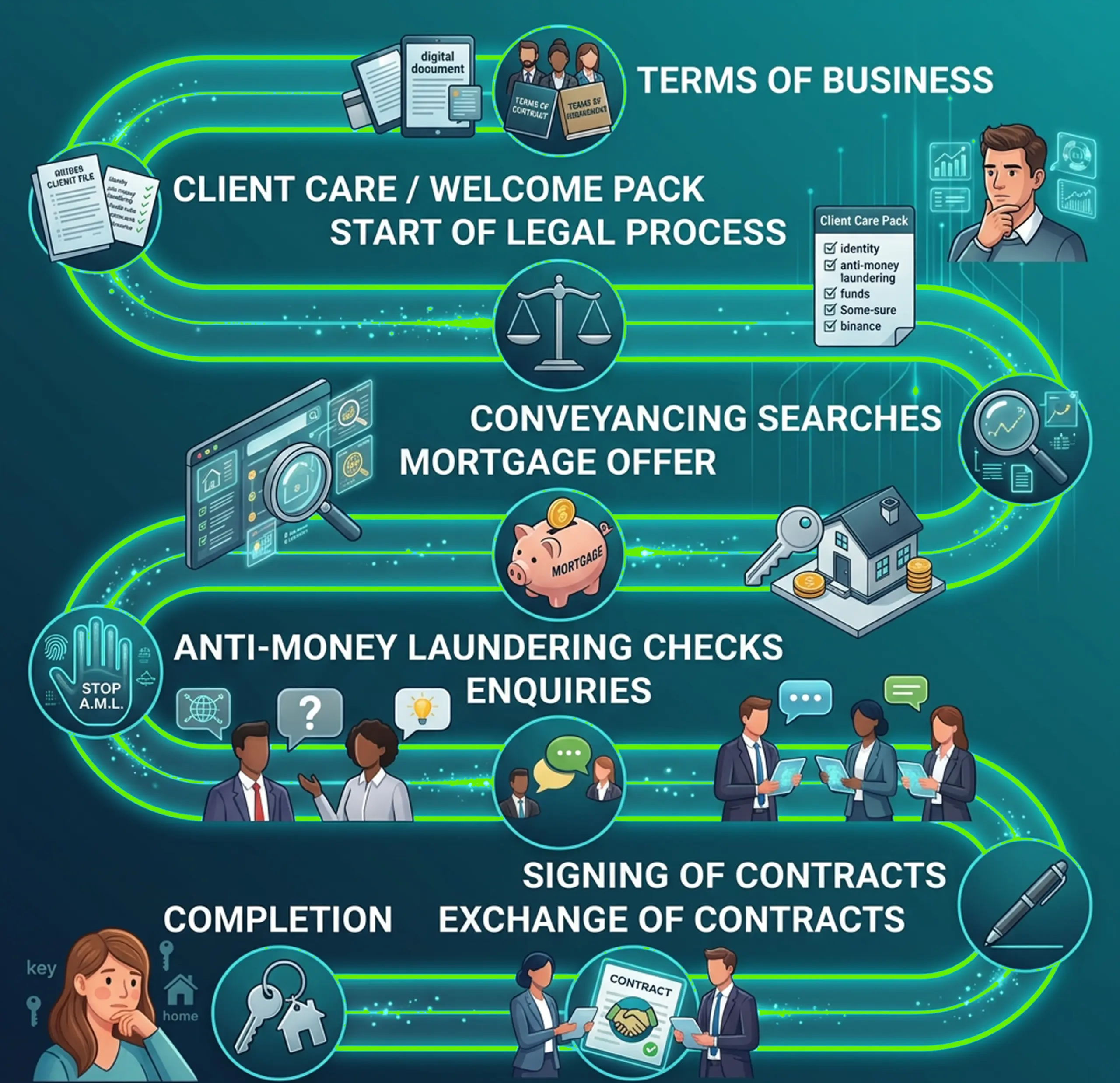
🏡 THE 6 KEY STAGES OF CONVEYANCING
The conveyancing process follows a broadly consistent sequence, although the timescale can vary depending on factors such as the length of the chain, the type of property being sold, and how quickly information is provided by all parties. Understanding each stage can help both buyers and sellers know what to expect and avoid unnecessary delays.
Stage 1: Instructing Your Solicitor and Completing Initial Paperwork
As soon as a sale has been agreed, both buyer and seller should instruct their chosen solicitor or conveyancer. Your solicitor will then send a client care pack containing forms, identification requirements, and details of the work they will be carrying out on your behalf.
This stage typically includes:
Providing proof of identity and address for anti-money laundering checks
Completing client questionnaires and instruction forms
For buyers, paying funds on account to cover the cost of searches
For sellers, completing the Property Information Form (TA6) and Fittings and Contents Form (TA10)
For sellers, completing the property forms accurately and promptly is one of the most effective ways of keeping a transaction on track. These forms provide important information about the property, including boundaries, planning permissions, disputes, guarantees, and exactly what will be included in the sale.
Stage 2: Contract Pack, Searches and Enquiries
Once instructed, the seller's solicitor prepares the draft contract pack and sends it to the buyer's solicitor for review.
The buyer's solicitor will then order a series of property searches to identify any issues that may affect the property or influence the buyer's decision to proceed.
Common searches include:
Local Authority Search – planning history, building regulations, road adoption and enforcement notices.
Water and Drainage Search – confirms connections to mains water and sewerage networks.
Environmental Search – identifies potential flood risk, contaminated land and ground stability issues.
Additional Searches – depending on the property's location or circumstances, further investigations may be recommended.
In Somerset, environmental searches can be particularly important, especially in areas affected by flood risk, including parts of the Somerset Levels and locations around Bridgwater.
At the same time, the buyer's solicitor will raise legal enquiries with the seller's solicitor. These questions may relate to alterations, planning permissions, rights of way, boundaries, guarantees, leasehold information, or any matters highlighted by the searches.
Prompt responses from sellers and their solicitors can significantly reduce delays at this stage.
Stage 3: Mortgage Valuation and Survey
For buyers requiring a mortgage, the lender will arrange a valuation of the property to ensure it provides suitable security for the loan.
It's important to understand that a mortgage valuation is for the lender's benefit and should not be relied upon as a detailed assessment of the condition of the property.
Many buyers choose to arrange their own independent survey, particularly when purchasing an older property or a home that may require repairs.
Common survey options include:
HomeBuyer Report – suitable for most modern and conventional properties, highlighting significant defects and maintenance issues.
Building Survey – a more comprehensive inspection often recommended for older properties, unusual construction types, or homes requiring renovation.
If a survey identifies concerns, discussions may take place regarding repairs, further investigations, or a possible renegotiation of the purchase price.
Stage 4: Mortgage Offer
Once the lender has completed its checks and is satisfied with both the property and the buyer's financial circumstances, a formal mortgage offer will be issued.
This is a major milestone in the transaction, as exchange of contracts cannot take place until the buyer's solicitor has received and reviewed the mortgage offer.
Buyers should avoid making significant financial changes during this period, such as taking out additional credit, changing employment, or making large purchases, as this could affect their mortgage application.
Stage 5: Exchange of Contracts
Exchange of contracts is the point at which the transaction becomes legally binding for both buyer and seller.
Prior to exchange, either party can withdraw from the transaction. Once contracts have been exchanged, both parties are committed to completing the sale on the agreed terms.
At exchange:
Contracts are formally exchanged between solicitors.
The buyer pays their deposit, typically 10% of the purchase price.
A completion date is agreed and fixed.
Exchange represents a significant milestone, providing certainty that the move will proceed.
Stage 6: Completion Day
Completion day is when ownership of the property officially transfers from seller to buyer.
On the day of completion:
The buyer's solicitor transfers the purchase funds to the seller's solicitor.
Once funds have been received, the seller's solicitor authorises the release of keys.
The estate agent releases the keys to the buyer.
The seller vacates the property, unless alternative arrangements have been agreed.
For buyers, this is the day you can move into your new home. For sellers, it marks the successful conclusion of the transaction and the beginning of your next chapter.
Following completion, the buyer's solicitor will deal with any Stamp Duty Land Tax requirements and register the change of ownership with HM Land Registry.
💡 Key takeaway: While conveyancing can seem complex, it follows a clear and structured process. The most effective way for both buyers and sellers to keep things moving is to respond promptly to requests for information, maintain regular communication with their solicitor, and make use of their estate agent's support throughout the transaction.
⏳ HOW LONG DOES IT TAKE?
This is one of the most common questions buyers and sellers ask, and the honest answer is: it varies.
A straightforward transaction involving no onward chain, efficient solicitors, and a cash buyer can complete in as little as four to six weeks. More complex sales involving longer chains, leasehold properties, or legal complications can take several months.
As a guide, most transactions complete within 12 to 16 weeks from sale agreed to completion.
The best way to keep your move progressing is to instruct a solicitor promptly, respond quickly to requests for information, and maintain regular communication with your estate agent and solicitor throughout the process.
⚠️ COMMON CAUSES OF DELAY
Understanding what causes delays can help buyers and sellers minimise the risk of them affecting their transaction:
Slow responses to enquiries – One of the most common and avoidable delays. Respond to your solicitor's requests promptly and provide as much information as possible.
Incomplete or inaccurate property forms – Sellers who rush forms such as the TA6 often generate additional enquiries, which can significantly slow the process.
Survey issues – If a survey highlights potential defects or concerns, further specialist inspections may be required to establish the extent of the problem and any associated costs.
Mortgage complications – Changes in employment, income, or credit commitments can delay or even jeopardise a mortgage application.
Chain dependencies – In a property chain, the progress of every transaction affects everyone else's timescale.
Incomplete links in the chain – Delays can occur where a buyer or seller is struggling to find a suitable property to purchase, preventing the chain from becoming complete.
Leasehold complications – Additional information is often required from managing agents or freeholders, and obtaining this can take several weeks.
Estate management and development charges – Properties on modern developments often have management companies and estate charges. Obtaining management information and replies to enquiries can cause additional delays.
💡 Top tip: One of the best ways to keep your transaction moving is to respond promptly to requests from your solicitor, provide accurate information from the outset, and maintain regular communication with your estate agent and mortgage adviser. If you're selling a leasehold property or a home on a modern development, ask your solicitor to obtain the management pack and estate management information as soon as they are instructed, as these are common causes of delay.
📢 HOW TO STAY INFORMED WITHOUT BECOMING OVERWHELMED
One of the most common frustrations buyers and sellers experience during conveyancing is the feeling of being left in the dark. Weeks can sometimes pass without any obvious progress, and it's perfectly normal to wonder what's happening behind the scenes.
Here are some simple ways to stay informed without letting the process take over your daily life:
Establish a communication routine with your solicitor. Agree how updates will be provided and how often. A weekly update is usually sufficient unless there is a specific issue requiring urgent attention.
Use your estate agent as a source of information. Your estate agent will be in regular contact with solicitors, buyers, sellers, mortgage advisers and other agents throughout the chain, providing a broader overview of how matters are progressing.
Avoid excessive chasing. Whilst it's important to remain proactive, daily calls and emails can sometimes be counterproductive. Allow professionals time to progress matters and focus on meaningful updates.
Keep your own checklist. Make a note of documents submitted, enquiries answered, and outstanding actions. This helps you stay organised and better understand where you are in the process.
Ask questions if you're unsure. Conveyancing involves unfamiliar terminology and procedures. Don't be afraid to ask your solicitor or estate agent to explain anything you don't understand.
Our role at Joseph Casson Estate Agency is to be your eyes and ears throughout the transaction. We work proactively with buyers, sellers, solicitors and mortgage advisers to monitor progress, identify potential delays early, and keep everyone informed from sale agreed right through to completion.
⚠️ WHAT CAN GO WRONG – And How Can You Protect Yourself?
While most property transactions reach a successful conclusion, it's important to remember that a sale is not legally binding until contracts are exchanged. Understanding the most common risks can help buyers and sellers navigate the process with confidence.
🏷️ Gazumping and Gazundering - In England and Wales, either party can change their position before exchange of contracts. This means a seller could accept a higher offer from another buyer, known as gazumping, or a buyer could reduce their offer shortly before exchange, known as gazundering.
Whilst both practices are relatively uncommon and generally considered poor form, the best protection is to keep the transaction moving, respond promptly to requests for information, and maintain open and positive communication between all parties.
🔍 Survey Issues - Sometimes a survey reveals defects that were not previously apparent, such as structural movement, damp, roofing concerns, or other maintenance issues. This doesn't necessarily mean the sale will fall through, but it may lead to further specialist inspections, renegotiation of the purchase price, or agreement over remedial works.
A good estate agent can often help facilitate these discussions and assist both parties in reaching a sensible outcome.
🔗 Chain Collapse - Where a transaction forms part of a chain, the withdrawal of a buyer or seller can impact everyone involved. Changes in circumstances, difficulties securing a mortgage, adverse survey findings, or simply a change of mind can cause a chain to break down.
Whilst this is largely outside your control, regular communication and proactive management can often identify potential issues before they become major problems.
💷 Mortgage Difficulties - Mortgage offers are usually valid for a set period, but lenders can reassess applications if circumstances change. Buyers should avoid changing jobs, taking on additional borrowing, financing large purchases, or making significant financial commitments between mortgage application and completion.
📄 Leasehold and Management Information Delays - For leasehold properties and homes on modern developments, delays can occur when information is required from managing agents, freeholders, or management companies. Obtaining management packs, service charge accounts, insurance details, and replies to enquiries can sometimes add several weeks to the transaction.
For this reason, sellers should ask their solicitor to request this information as early as possible.
✅ The Good News
Most issues that arise during conveyancing can be resolved with clear communication, realistic expectations, and proactive management. Having an experienced estate agent overseeing the transaction can make a significant difference, helping to identify potential obstacles early and keeping all parties focused on achieving a successful completion.
🤝 A Final Word: You're Not Alone in This
The conveyancing process can feel like a long and uncertain road, particularly if it's your first move or you're navigating a complex chain. However, every stage has a purpose, every enquiry requires an answer, and most challenges can be overcome with the right advice and support.
At Joseph Casson Estate Agency, we've helped countless buyers and sellers across Bridgwater, Taunton and the wider Somerset area successfully navigate the journey from sale agreed to completion. While agreeing a sale is a significant milestone, it's often where our work really begins.
We work closely with buyers, sellers, solicitors, mortgage advisers, surveyors and other agents to help keep transactions progressing, provide regular updates, and resolve issues before they become major obstacles. Our aim is simple: to make your move as smooth and stress-free as possible while ensuring you're kept informed every step of the way.
Whether you're buying, selling, or managing both sides of a move, our experienced team is here to guide you through every stage of the process and help ensure your move progresses as smoothly as possible.
Get In Touch
📞 01278 258005
📧 office@josephcasson.co.uk
🌐 www.josephcasson.co.uk
Helping buyers and sellers move with confidence across Bridgwater, Taunton and Somerset.
Our office is open Monday to Friday, 8:45am - 5:30pm, and Saturday, 9:00am - 12:00pm.